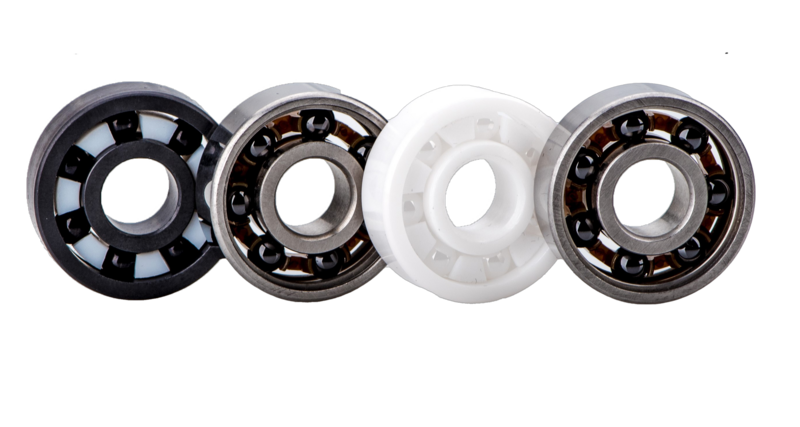
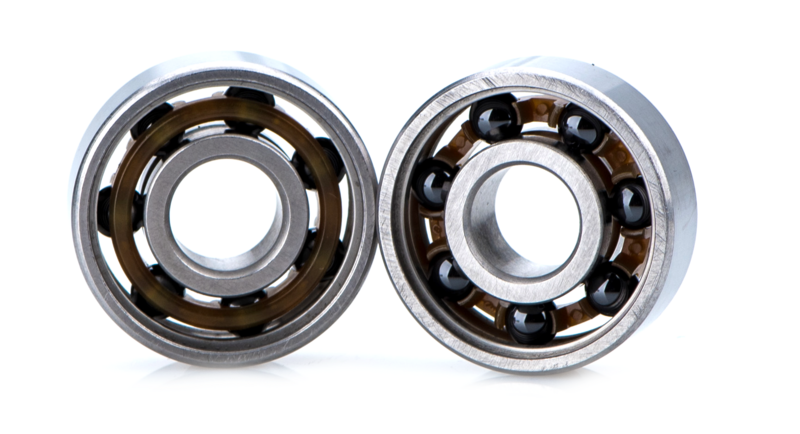
Ceramic bearings with high temperature resistance, corrosionresistance, wear resistance,no magnetic, electrical insulation,self lubrication, high speed, long life and other metal materials donot have the characteristics, rings and roller with ceramicmaterials (ZrO2), silicon nitride(Si3N4), silicon carbide(SIC),alumina(AI2O3), cage with PTFE, nylon 66, polyether imideammonia, irconia, stainless steel or special aviation aluminummanufacturing, to expand the application of ceramic bearings:which are widely used in aerospace, chemical,metallurgy, machinery, green energy petroleum,electronics fields.
When installing a ceramic bearing, apply uniform pressure around the entire end face of the bearing ring to press the ring into position. Never strike the end face of the bearing ring directly with a hammer or other heavy object, as this may damage the bearing.
In addition, applying installation force to only one side of the bearing ring—for example, pressing only the outer ring—may cause indentation or scoring on the raceway and must be avoided.
This is especially important when installing a non-separable bearing onto both a shaft and a bearing housing at the same time. As shown in the diagram below, use a suitable support block or pressing fixture to apply balanced pressure to both the inner and outer rings simultaneously.
The inner and outer rings of a rolling bearing must be securely mounted on the shaft or in the bearing housing. When the bearing is subjected to load, there should be no relative movement between the bearing rings and their mating surfaces in the radial, axial, or rotational directions.
Such relative movement can cause wear, fretting corrosion, or surface cracking on the mating surfaces, potentially damaging the bearing, shaft, and bearing housing. The resulting wear particles may also enter the bearing, leading to poor running performance, abnormal heat generation, vibration, and other operational problems.
For bearing fixation, an interference fit between the bearing ring and the shaft or housing is generally the preferred method. A properly selected interference fit distributes the bearing load evenly around the circumference of the ring without adversely affecting the bearing's load-carrying capacity.
However, a tight or interference fit can make bearing installation and removal more difficult. In applications where the free-side bearing uses a separable bearing design, axial movement may also be restricted. Therefore, an interference fit is not suitable for every application. For specific installation requirements or fit selection, please contact our company for technical assistance.
The selection of a bearing fit should generally be based on the following factors:
Direction and magnitude of the applied bearing load
Nature of the load
Direction of rotation of the inner and outer rings
Depending on these operating conditions, the load acting on a bearing ring can generally be classified as a rotating load, stationary load, or indeterminate load.
For a ring subjected to a rotating load or indeterminate load, an interference fit (tight fit) should generally be used.
For a ring subjected to a stationary load, a transition fit or clearance fit may be used, depending on the application.
When the bearing is subjected to heavy loads, vibration, or impact loads, a greater interference should generally be considered. When using thin-wall bearings, the interference may also need to be increased appropriately.
For applications requiring high rotational accuracy, high-precision bearings should be used, together with high-precision shafts and bearing housings. Excessive interference should be avoided because it may adversely affect the geometric accuracy of the shaft or bearing ring.
If the interference is excessive, deformation of the shaft or bearing ring may occur, resulting in reduced bearing accuracy and potentially affecting operating performance.
For separable bearing designs, such as deep-groove ball bearings, if both the inner and outer rings are installed with interference fits, bearing installation and removal can become extremely difficult. Therefore, it is generally preferable to use a clearance fit on one of the two rings.
| Composition of Ceramic BearingsHybrid ceramic bearings are made of silicon nitride (Si3N4), zirconia (ZrO2) and shaft steel, stainless steel materials. Under normal circumstances, ceramic bearings will be harder than stainless steel bearings, because silicon nitride and zirconia ceramic materials are known for their high hardness and wear resistance, which makes them an ideal choice for bearings operating at high speeds and high loads. |
Characteristic of Ceramic BearingsCeramic bearings have higher chemical and corrosion resistance, can operate in more extreme environments, and are less affected by thermal expansion and contraction than ordinary materials. Therefore, when the clearance of the bearing is fixed, the bearing can be allowed to work in the environment where the temperature difference is more drastic.
Compared with ordinary bearings, ceramic bearings have higher corrosion resistance, hardness, impact strength and longer service life. |
|
 | Application of Ceramic BearingsCeramic bearings are widely used in aviation, aerospace, navigation, petroleum, chemical, automobile, electronic equipment, metallurgy, electric power, textile, pump, medical instruments, scientific research and national defense and military fields. |